
❮
![Large Image]() ❯
102nd & 173rd New York Infantry - Libby Prisoner - NEW
Item CDV-12089
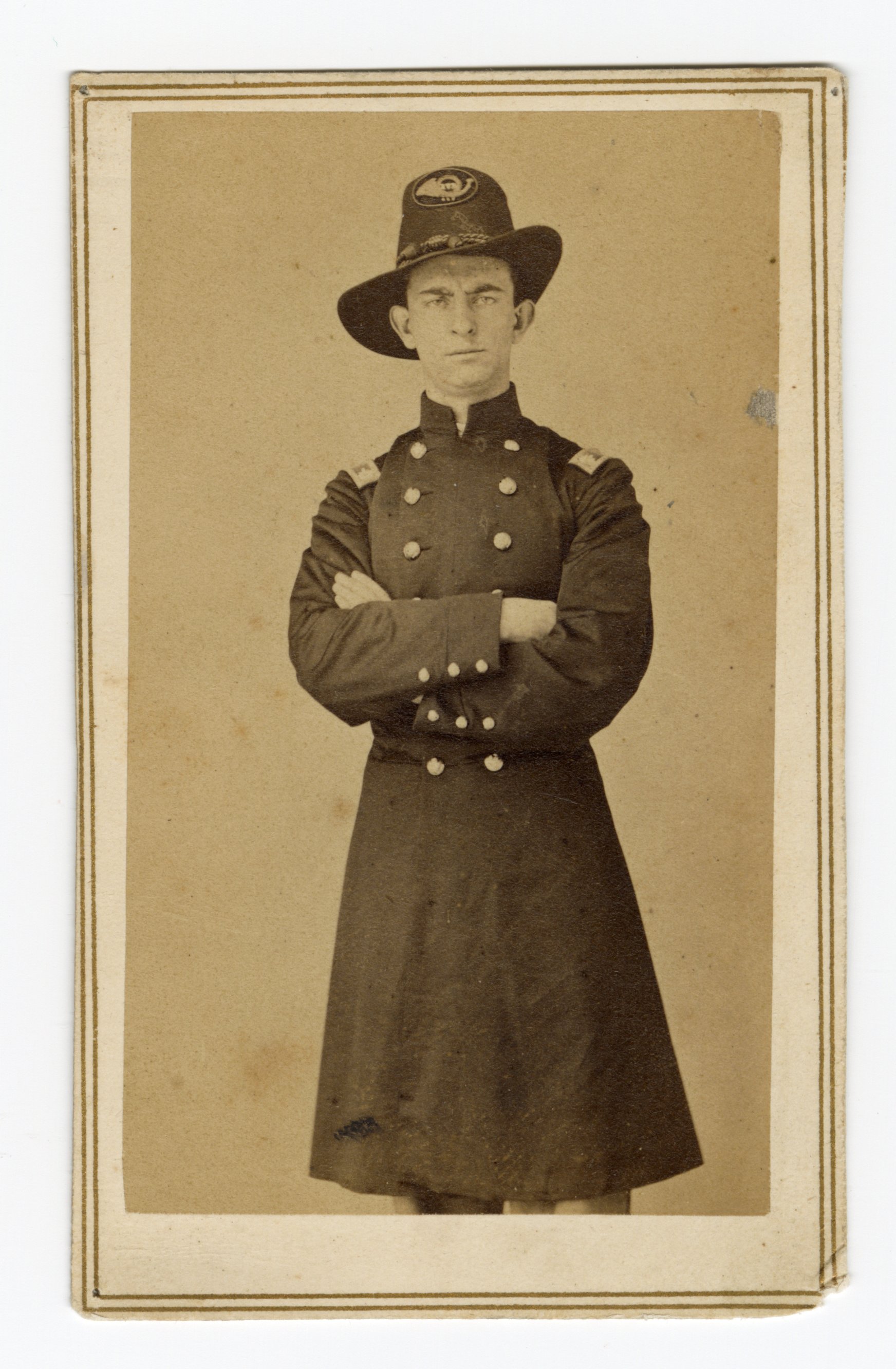
William Nelson Green Jr.
Price: $425.00
Description
William Nelson Green Jr.25th Massachusetts Infantry
102nd Neww York Infantry
173rd New York Infantry
Captured at Cedar Mountain, VA
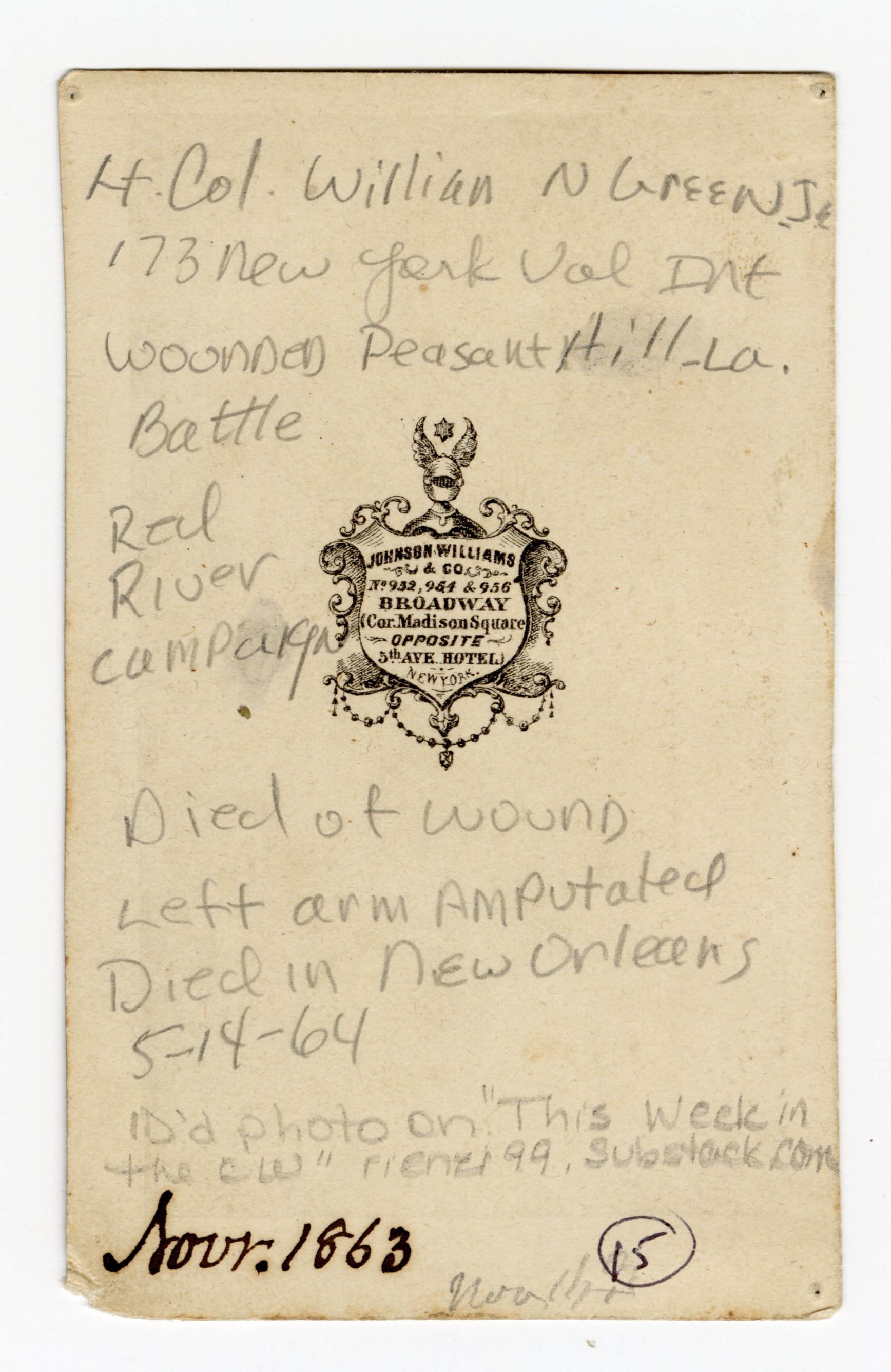
Wounded at Pleasant Hill, LA
Backmark: New York, NY
Identified on "This Week in the Civil War," www.rienzi99.substack.com
William Nelson Green, Jr.
Green was born into a prominent family in Worcester, Massachusetts. His father (William Nelson Green Sr.) served as a judge for the Worcester Police Court and his uncle Andrew Haswell Green became known as the ‘Father of Greater New York.’ A.H. Green was a prominent lawyer and civic reformer in New York City and was the primary visionary behind the consolidation of the five boroughs into a single city. He also served as the president of the Central Park Commission, helped found the Metropolitan Museum of Art, the American Museum of Natural History, and the Bronx Zoo, oversaw the formation of the modern New York Public Library, and served as City Comptroller.
Green enrolled in the Phillips Academy in Andover in 1859, but left the school in September 1861 to enlist as a private in the 25th Massachusetts. He participated in the Burnside’s North Carolina coastal expedition including the successful amphibious landing on Roanoke Island before being discharged in March 1862 to accept a commission as a lieutenant in the 102nd New York. In August 1862, the 102nd N.Y. suffered heavy casualties in the fighting at Cedar Mountain, Virginia, losing over half of its men. In the confusion of the retreat, Green was captured and became a prisoner of war. He was confined at Libby Prison in Richmond, Virginia, for 46 days before being exchanged. Green returned to active duty in December 1862, and was promoted to captain. He participated in the ‘Mud March’ and performed picket and garrison duty during the winter of 1862 and the spring of 1863. In May, the Green and the 102nd N.Y. was involved in heavy fighting at Chancellorsville and occupied a critical position near Fairview and the Chancellor House.
In June 1863, Green secured a promotion to lieutenant-colonel and transfer to the 173rd New York, which was part of the Union forces besieging Port Hudson, Louisiana. As was the case in his earlier promotions, Green’s new assignment came as a result of the relentless lobbying and connections of his uncle A.H. Green within the New York political establishment. Green joined the 173rd N.Y. for the final weeks of the Port Hudson siege. In July 1863, Green’s unit moved to New Orleans for garrison duty until November 1863, when they took part in operations in the Bayou Teche region.
In the spring of 1864, Green and the 173rd New York took part in Nathaniel P. Banks’ Red River Expedition. On April 8th, Green’s regiment was heavily engaged at Sabine Cross-Roads as part of William H. Emory’s division. The following day in the fighting at Pleasant Hill, Green was severely wounded in the left arm, which was amputated on the field. He was transported to a military hospital in New Orleans, where he survived five weeks before dying of his wounds on May 14, 1864, at age 21. Source: Sketch of 171 New York and This Week in the Civil War: General Officer Fatalities: William Nelson Green Jr. (1843-1864)
“The One Hundred and Seventy-third, together with the brigade, held the front line—in fact, they were the outlying advance guard of the army. The enemy was enabled, in the dense wood that concealed his movements, to pour a destructive fire into their ranks, but they tenaciously held their ground, resisting the terrific onslaught bravely. Our brigade commander, Colonel Lewis Benedict, fell at this fire, completely riddled with bullets. The regiment was, however, nearly surrounded, but managed to cut its way through and escape, but not without losing two hundred out of four hundred men. Lieutenant-Colonel Green, an efficient and estimable officer, received here his death-wound.”
Green’s body was transported back to Massachusetts for burial in the Worcester Rural Cemetery. Following the death of his nephew, Andrew H. Green was able to secure his posthumous brevet promotion to brigadier-general to recognize his nephew’s “gallant and meritorious services” during the Red River Campaign.
Source: Sketch of 171 New York and This Week in the Civil War: General Officer Fatalities: William Nelson Green Jr. (1843-1864)